Saturday, 21 February 2015

What am I doing here?

If, having seen the title of this post, you are hoping to read an existential theory about the meaning of life then I am sorry to have to disappoint you. If, however, you are interested in what I am doing with Medair in the Philippines then please read on.

On 8th November 2013 Super Typhoon Haiyan, known locally as Yolanda, struck the Philippines causing widespread destruction. It is estimated that around 6000 people were killed, a million homes were damaged or destroyed and four million people were displaced.

Much of the initial relief effort focussed on Tacloban City, which was home to over 200,000 people and was virtually decimated by the high winds and the resulting storm surge (a wall of water with waves up to 25 feet in some places). There was widespread destruction across Leyte Island and Medair decided to work in Dulag Municipality, which is around 30 kms south of Tacloban.

The path of Typhoon Yolanda, tracking east to west.
The first place where it struck landfall is pretty much where I am right now.
After an initial programme, which built 600 houses for the most vulnerable in the community, we are now in the second phase which has four main objectives: 
  1. To build a further 1080 houses for others whose homes were completely destroyed
  2. To provide building materials and training to another 1200 households whose homes were severely damaged and who do not otherwise have the means to repair them
  3. To return to the 600 houses built in the initial phase and provide assistance, where necessary, to improve them
  4. To give all these households training and equipment to help them protect their homes in any future typhoon
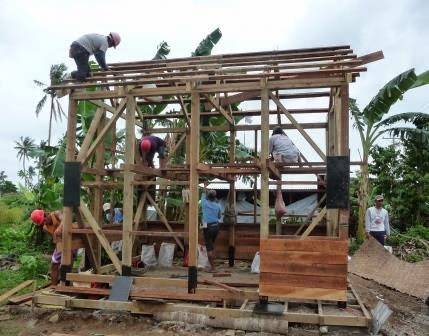
Here are some pictures to show what the houses look like in the various stages of construction.

Laying the foundations
The house starts to take shape


Almost finished. Here the owner is cementing the area in front of their new home

A mother and child - happy to show off their new home
None of this can be done without money, staff and materials and that is where I come in. My responsibilities are to oversee the Finance, HR and Logistics activities of the programme. These are often the ‘hidden’ elements of any programme, but are essential to its smooth running.
  • Every penny (or in this case peso) spent has to be accounted for
  • We are currently employing 166 local people, half of them carpenters who are building the houses
  • Sourcing, storing and transporting all the materials required to build or repair nearly 3000 homes is a significant undertaking
As the programme is scheduled to be finished by September this year a lot of progress has already been made and I am following on with the work done by others before me. It’s challenging, busy and diverse work, which I’ll blog about in more detail another time. 

Maybe one day I’ll also write about the meaning of life – but I wouldn’t hold your breath waiting for that post…!

Saturday, 14 February 2015

10 random things...

…I’ve learnt about life in The Philippines since arriving here just over two weeks ago.

1. Karaoke is VERY popular.
 
2. You do not put toilet paper down the toilet – you dispose of it in the bin provided.
 
3. Clothes are dried by hanging them outside your house on hangars. I’m so used to seeing second-hand clothes for sale on the streets in East Africa that it took me a few days to realise these clothes were not for sale…
 
4. A favourite dish is lechon. This is a young pig (about six months old) that is cooked whole on a spit.
 
5. The most common form of public transport is the pedicab. This is a bicycle with a side-car and a typical journey will cost 5 pesos (about £0.07p or $0.11)

 
6. There are a lot of dogs. Most of these are strays although some do seem to belong to people. They all wander the streets during the day and night, fighting and barking.
 
7. Food can often be an unusual mix of sweet and savoury. Bread is usually sweet and finding cheese in a fruit salad was an ‘interesting’ taste sensation!
 
8. Cock fighting is a popular sport, drawing large crowds to purpose-built auditorium.
 
9. Each town or city is divided into smaller districts, known as Barangay. Each Barangay has its own council along with a ‘Multi-Purpose Hall’, which is the equivalent of a community centre or village hall. The Barangay we live in is just one street but there is still a sign that welcomes you at one end and says ‘Thank you for visiting’ at the other end.
 
10. February is meant to be the start of the dry season but it is still raining a lot. Nearly every day there are heavy downpours accompanied by strong winds, which blow the rain at all angles. Some days these showers last for just a few minutes but on other days, like today, it seems to rain virtually all the time.

Saturday, 7 February 2015

Welcome to The Philippines

Ten days ago arrived in The Philippines. I will be working with Medair for much of this year as they continue to respond to the devastation caused by Typhoon Haiyan in November 2013. I will blog more about the project at another time but for now here are some of my first impressions of this country.


It is beautiful. I flew from Manila to Tacloban on an early morning flight and the sun was rising as we came in to land. The ocean, the forests and the mountains in the distance were bathed in the glorious early morning light.

It is scarred. From the moment of leaving the airport and all along the 45 minute drive to Dulag, where the Medair project is based, you can see the impact of the typhoon. There are huge numbers of buildings either partially or totally destroyed. You can see the power of the typhoon in the twisted and crumpled metalwork and collapsed walls of structures that were once functioning as factories, offices, schools and homes. You can see the impact on individuals in the broken down houses, many covered in tarpaulins as their only defense against the elements now.

It is recovering. Amidst the destruction there are newly rebuilt or repaired buildings, standing as a beacon of hope for what is possible.

It is Roman Catholic. A few weeks ago the Pope visited Tacloban and the banners to welcome him are still hanging in the streets. Many of the buildings that have been rebuilt are churches. Our rented office and one of our warehouses both have shelves containing icons and statues of the Virgin Mary.

It is tropical. Although this is now meant to be the dry season it still seems to rain every day in short bursts of heavy rain. In between the rain showers the sun shines and the temperature and humidity levels rise to the point where a fan is an essential piece of equipment in order to keep cool.

It is friendly. People seem very open and always pleased to see you. The adults will say 'Good Morning / Afternoon / Evening' as you pass them in the street and the children will put up their hands for a high five and ask 'What is your name?'

It is noisy. I think we are living on the corner of a particularly noisy street but there is rarely a moment (except maybe in the middle of the night) when you could say it was truly quiet. The roar of motorbike engines, the barking of the multitude of stray dogs that roam the streets, the (mostly) tuneless karaoke singing, the banging and hammering of construction and the chattering and shouting of the neighbours all contribute to a constant cacophony of sound. I am getting used to sleeping with ear plugs!

Over the next few months I am sure I will learn a lot more about the culture and the people of this country that is all a new experience for me.

Sunday, 14 December 2014

The Last Time?

Yesterday I drove to the nearest, well-stocked supermarket to where I am currently living (Embassy Supermarket, so called because of its proximity to the US Embassy in Kampala) to buy a few essential items to keep me going during my last week in Uganda.

I looked up at the shop as I was driving away and wondered if this would be the last time I would ever go there. And, with my flight home booked for this coming Friday, that set off a whole train of thought about my experience of living in Kampala over the last 6 months.

Will this be the last time I:
  • Buy milk in plastic bags
  • Get to disobey all the 'normal' rules of the road because those rules just don't seem to apply here and the only way to get anywhere is to drive like everyone else
  • Look out on Lake Victoria, shimmering in the distant heat

  • Be woken up at night by random car alarms, barking dogs, loud music from nearby bars and the early morning call to prayer
  • Marvel at the spectacular force of an African rain storm

  • Have my Saturday afternoon and Sunday morning accompanied by the singing of the local church choir, amplified through a poor quality PA system
  • Eat the best avocados I've found anywhere in the world
  • Wear shorts and a t-shirt in December
  • Discover amazing birds as I walk to work in the morning

  • See the people who have, in a short space of time, become my friends
  • Spend time in this beautiful country?

I don't know the answer to these questions and leaving is always both hard and exciting. It's hard to leave behind all the people and places that have become so familiar but exciting to be going home to see family and friends again.

Saturday, 29 November 2014

In the news

There have been two main topics of conversation around the lunch table at the office this week, both of which have also been the subject of international media attention.

It is unusual for local Ugandan news to be reported further afield but both of these stories involved young children and have highlighted two different aspects of life in Kampala.

The first story was the tragic death of a toddler, run over by a city council vehicle after his mother was arrested and taken to the council offices for illegally selling fruit on the streets. Street-sellers are an everyday part of life here, as they are in many cities across the world. It's not an easy life either sitting by the side of the road or walking up and down between the traffic at busy road junctions trying to sell your wares. For many people though it is the only way to make a living in order to be able to provide for their families. The selection of things for sale is always diverse: newspapers, scratchcards providing phone credit, chewing gum, toilet paper, fruit, nuts, phone chargers, memory sticks, belts, pirated DVDs, posters - the list goes on and on.

But Kampala Capital City Authority are trying to tidy up the city and have been clamping down on these hawkers. Depending on your point of view this child's death is either a consequence of this tough policy or just a tragic accident but it does highlight the difficult lives of many people in this growing city where jobs are hard to come by. The other victim of this story is the driver of the vehicle, who is now in prison and whose life has also been changed forever.

The second story was the horrific abuse of a small child by her nanny, which was filmed with hidden cameras and has shocked and shaken the country. This story involves a family whose lives are as far removed from those of the street-sellers as mine. They are part of the growing Ugandan middle-classes, who have received a good education and now have well-paid jobs and spend their leisure time at the modern shopping malls and restaurants that are springing up all over the city. They choose to continue with their careers after having children and can afford to pay for childcare, either in a day care centre or one-to-one in their own home. Unfortunately the demand for childcare is growing faster than the training and vetting of such staff. This story has highlighted the inadequacies and failings of the current system and has acted as a wake-up call to many parents and to the authorities.

These stories have mainly just left me feeling sad. I am sad for the people involved: for the parents whose child was killed, for the driver, for the little girl so badly beaten, for her parents who have to live with the consequences of their decisions and for the nanny who, although her actions cannot be condoned, is probably also a victim herself. I am also sad for this country: Uganda has so much about it and its people that is good and positive which never gets reported.

Unfortunately stories like these only serve to reinforce the stereo-typed view of the African continent that needs saving from itself rather than of an Africa that is diverse and vibrant and beautiful and is increasingly able to work through its problems and find its own solutions. 

Saturday, 1 November 2014

My daily commute

Every morning from Monday to Friday I walk the 1 km from where I am currently living to the office where I work. Every evening I walk the same route back home again. It’s a part of the day I really enjoy. In the morning the air feels relatively clean and fresh before the sun gains its full strength and the pollution of the Kampala traffic tightens its grip on the city once again. In the evening, after a day spent sitting at a desk, I relish the opportunity to get the blood pumping through my legs again.

It’s not a quiet road by any means. There are always other people walking the same route as me; walking along the side of the road trying to dodge our way between the traffic – the bicycles, the boda-boda, the mini-bus taxis, the cars and the lorries. Kampala traffic is unpredictable and you can never be sure what a driver is going to do. Despite having to concentrate quite hard on what other road users are doing I enjoy the opportunity to just observe the sights and sounds of life being lived on one small stretch of road. 
  • There is inevitably a man struggling to push a heavily laden bicycle. The things being transported may change – one day it could be crates of soda or beer stacked three or four high on the saddle, another day it might be enormous bags of charcoal, on a different day it could be several large bunches of matoke – and it will be a different man on a different day but it is always an effort and I marvel at how he manages it.
  • There are numerous small kiosks, painted in the distinctive colours of the different mobile phone networks, offering ‘Mobile Money’. Sending money to family and friends through your mobile phone and paying utility bills in the same way has made life so much easier for people across Africa. Supporting your extended family financially is an accepted part of life and that money can now be sent easily to those living on the other side of the country. My favourite kiosk is the one that also sells pens, paper and envelopes. They advertise their wares with three words painted on the wall. It reads: ‘Stationary Mobile Money’. Surely a contradiction in terms!
  • One kiosk I pass informs everyone in big black letters that it is NOT FOUR SALE.
  • In the morning I walk past a lady setting up a small stall from which she sells fruit and vegetables. It’s a limited selection of tomatoes, onions, potatoes (called Irish here), sweet potatoes and matoke. She is still there in the evening and it always seems to me that she has hardly sold anything all day.
  • In contrast, and a bit further up the street, there is a cage that in the morning is crammed full of scrawny and rather noisy chickens. Perhaps they know their fate and are taking a last opportunity to be heard as by evening the cage is inevitably empty – someone, somewhere not too far away, will be having ‘Chicken Tonight’!
  • There are also chickens running free – either scratching around in the dirt or playing their own version of chicken as they weave in and out of the traffic. I had to do a double take this week when I saw a group of chicks all with bright purple feathers chasing after their mother.
  • There’s no mistaking the line of business of ‘Unique Sounds – Music For Your Function’, as they blast loud music through the large speakers outside their shop. There is a certain irony to the fact that directly opposite their premises is ‘Peace Nursery School’.
Writing this makes me look forward to what I might see next week as I make my way to and from work. Two things I know already – it will not be predictable and it will not be dull.

Sunday, 26 October 2014

A Cacophony of Sound

Sunday morning. The day of rest. The one day of the week when you can take things a bit easier. Don’t set the alarm. Take time to wake up. Enjoy a slower start. If only it worked like that here.

This is a big city, bustling with people all living in close proximity to one another and every day seems to start as soon as the sun rises over the horizon, bringing with it the first rays of light.

The call to prayer wakes me each morning between 5.30 and 6.00 a.m. This is not as early as in some places I have lived but I seem to be staying very close to a mosque so it is by far the loudest I have experienced. Fortunately this Imam is mercifully brief in his cry although once he has finished it is followed by the distant chorus of other Imams also calling their congregations to pray.

Within minutes Christian worship songs fill the air. A choir at a nearby church practised for several hours on Saturday afternoon but as I desperately try to cling to the last moments of sleepiness I cannot tell whether this is the choir singing or just a neighbour playing their favourite music.

The man-made sounds are replaced with birdsong. A beautiful and varied chorus which has the effect of relaxing me again and I start to fall back to sleep. And then the ibis joins in with its loud, shrill, monotonous call and I am wide awake once more.
The ibis - one of the noisiest birds I've ever heard.
My desire for sleep has been defeated by this auditory assault. Never has the saying ‘if you can’t beat them join them’ felt more applicable. Time to get up, make a cup of tea and start my day just like the rest of the inhabitants of this lively city.